Some businesses are measured by the products they sell. Others become landmarks because of what they represent. For decades, Back Home Bakery has been one of those places.
Located at the intersection of Church and Brooklyn Avenue in Brooklyn, New York, the bakery has long been a destination for Guyanese families searching for familiar flavors that remind them of home. Originally established by Guyanese owner Mr. Vernon Johnson, the bakery earned a reputation for serving fresh bread, pastries, and traditional baked goods that became woven into the routines of the Caribbean community. When Mr. Johnson decided it was time to step away, he entrusted the business to Sean, a lifelong Brooklynite who immediately understood that he wasn’t simply purchasing a bakery. He was becoming the steward of a legacy.
During our conversation, Sean admitted he still finds it difficult to believe he was given the responsibility of carrying forward a business that means so much to the Guyanese diaspora. Rather than reshaping the bakery into something entirely new, he chose to preserve what made it special while thoughtfully expanding its reach.
That decision becomes clear the moment customers walk through the front door.
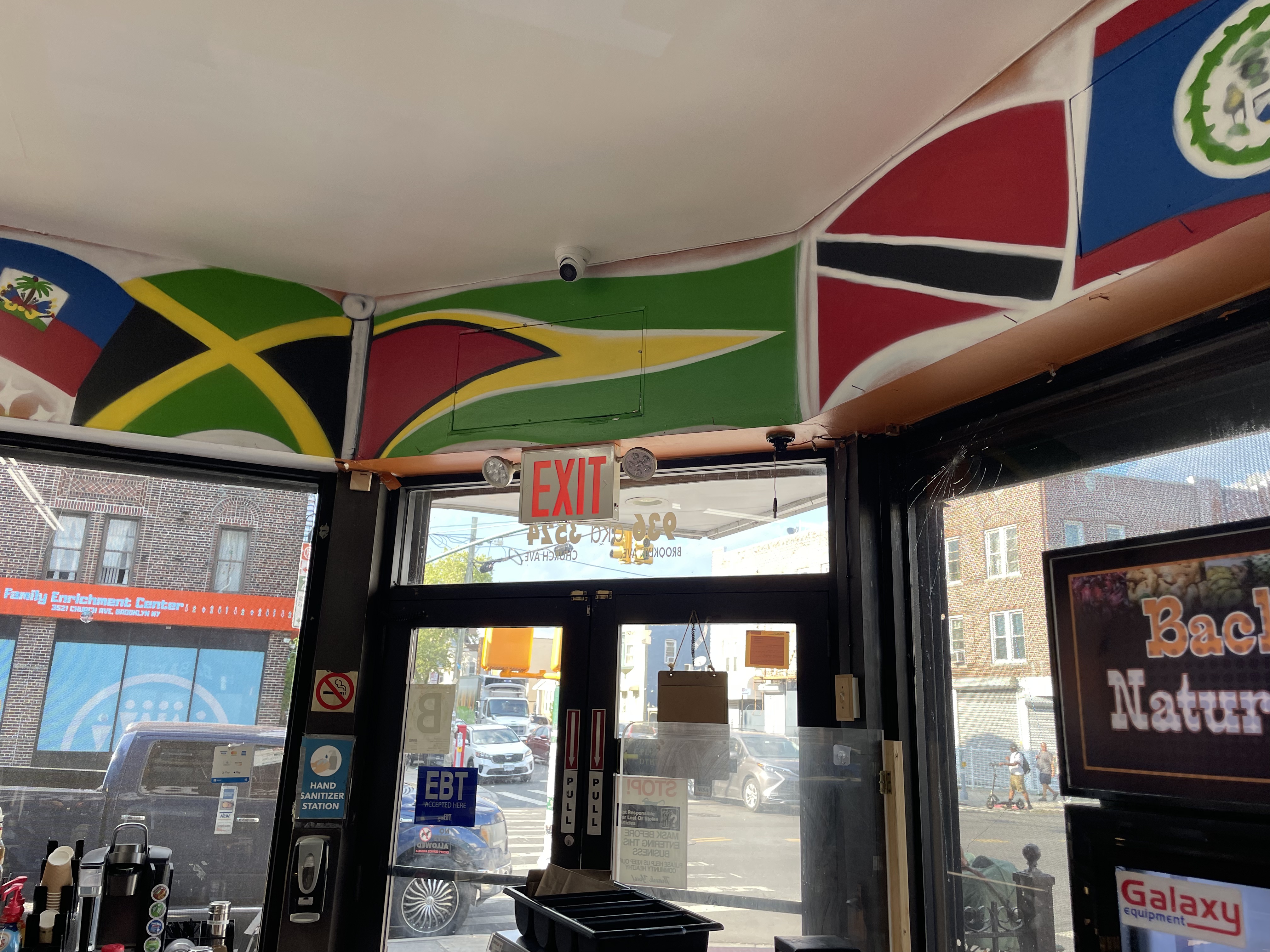
Flags representing nations across the Caribbean line the walls, acknowledging the many communities that now call Back Home Bakery their own. Yet one flag occupies a place of special significance. Above the entrance hangs the Golden Arrowhead of Guyana. Sean intentionally placed it there as a tribute to the bakery’s founder and to remind every customer leaving the shop that this business began as a Guyanese Immigrant dream.
It is a simple gesture, but one that speaks volumes.
Like the neighborhood surrounding it, Back Home Bakery has continued to evolve. Brooklyn’s changing landscape has introduced new residents, new businesses, and new opportunities. Sean views those changes not as a threat but as an invitation. As the neighborhood has become more diverse, so too has the bakery’s customer base. People from different backgrounds, including Jewish, Latino, Black and White Americans, and other communities, now walk through its doors curious to experience Caribbean baking for the first time. For Sean, every new customer becomes an opportunity to introduce someone to the flavors that have long connected Caribbean families to home.
That reach now extends far beyond Brooklyn.
Sean proudly shared that one of the bakery’s signature products, its beloved plait bread, has found its way across the United States to places like Texas and has even been shipped internationally to Africa. For many members of the diaspora, receiving a loaf of bread from Back Home Bakery is more than a delivery. It is a reminder of childhood breakfasts, family gatherings, and the simple comfort of familiar tastes thousands of miles away.
Ironically, the bakery sits at what feels like an intersection in more ways than one.
Not only do Church and Brooklyn Avenues meet outside its doors, but so do the traditions of the Caribbean. During our interview, Sean smiled as he described how customers from different islands often ask for the same products using entirely different names. A Guyanese customer may walk in looking for red bread, while a Trinidadian might use the name Salara for the identical pastry. The recipes remain remarkably similar or the same for most products, even when the language changes. The differences are small, but together they tell a larger story about a region connected by shared history, migration, and food.
Food, Sean believes, has always been one of the Caribbean’s greatest unifiers.
Although his mother is Trinidadian and he was born and raised in Brooklyn, Sean grew up surrounded by Guyanese, Jamaicans, Trinidadians, and neighbors from throughout the Caribbean. Church Avenue became more than the street where he lived. It became the classroom where he learned that Caribbean identity is built through community as much as nationality. He laughed as he recalled eating pepperpot for the first time without fully appreciating its significance. Looking back now, those experiences helped prepare him for the role he would eventually inherit.
While honoring tradition remains central to the bakery’s mission, Sean also recognizes that communities evolve, and their needs evolve with them. During our conversation, we connected his work to an earlier discussion with Dr. Aliya Shafi about diabetes prevention within Guyanese and Caribbean communities. Sean explained that the bakery has intentionally expanded its menu to include healthier choices, offering wheat breads, steamed vegetables, and options for vegan customers, groups he believes have often been underserved. His goal is not to replace the traditional foods customers cherish, but to ensure that everyone can find something that allows them to celebrate their culture while making choices that support their health.
That philosophy reflects something larger than food. It reflects care.
Back Home Bakery continues to preserve the recipes that built its reputation while adapting to serve the next generation of Caribbean families. It remains proudly rooted in its Guyanese origins while opening its doors to an increasingly diverse community, proving that honoring tradition and embracing change do not have to compete with one another.
As our conversation came to a close, we thanked Sean for something he may not fully realize.
For members of the Guyanese and West Indian/Caribbean diaspora, the words “Back Home” carry extraordinary meaning. They remind us of places we left behind, families we miss, and memories we continue carrying with us wherever life leads. By preserving a bakery that has served as a cultural landmark for so many years, Sean is doing more than operating a business. He is protecting a piece of Guyanese history while ensuring that future generations, regardless of where they were born, will always have a place where home feels just a little closer.
After the Makers.
Berbice Peace® 🇬🇾