Cultural Category:
Practice / Memory / Continuity
Context
Roti is a staple across Guyanese households, served with curry, stew, or beans, and present in both everyday meals and moments of gathering. While widely eaten, the knowledge of how to make roti is often passed down informally, through observation and repetition within families.
In the diaspora, this process of transmission is not always guaranteed. Distance, time, and generational shifts can interrupt what was once learned naturally. As a result, practices like roti-making become something that must be intentionally revisited and shared.
Main Entry
In a kitchen in New York, three generations came together, not simply to cook, but to learn.
Auntie Sandy, based in New York, first learned to make roti at the age of thirteen. Taught within her family by her Berbician mother, her roots trace back to Georgetown, Guyana, where the practice was not formalized, but observed, repeated, corrected, and eventually carried.
Now, years later, she opens her kitchen to us for an inter-generational roti-making learning experience.
What unfolds is not a class in the traditional sense. There are no measurements written down, no strict instructions followed step-by-step. Instead, there is guidance, hands adjusting dough, small corrections made in real time, and moments of laughter when the heat of the tawa becomes too much to handle.
The process begins simply: flour, a pinch of baking powder, and lukewarm water. The dough is kneaded until it reaches the right consistency, firm, but workable. From there, it is rolled out using a belna on a flat surface, shaped into a circle.
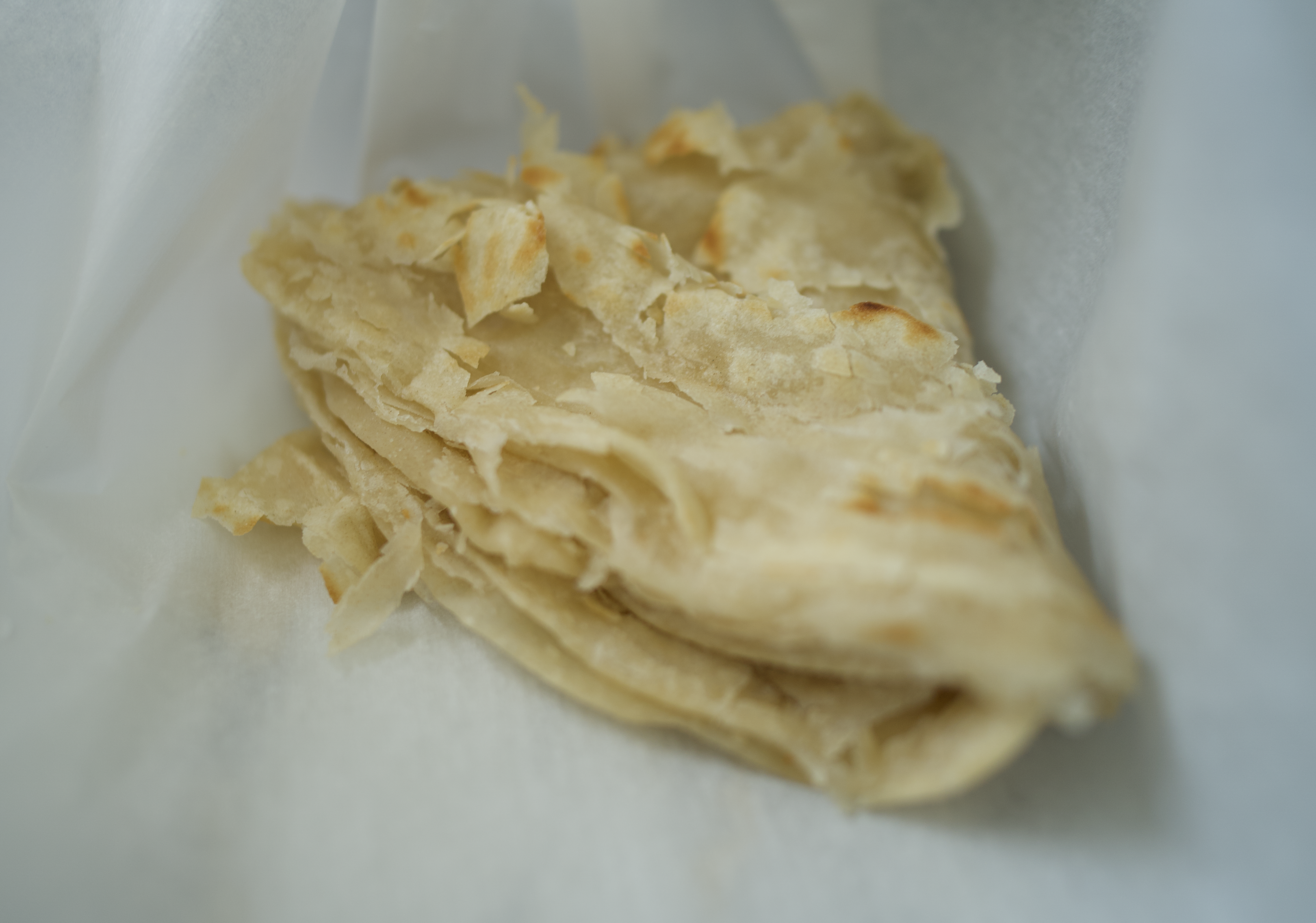
On the tawa, the roti is watched closely. It is flipped, lightly oiled, and turned again. The timing is not exact, but understood. The goal is not a deep brown, but a balanced finish, cooked through, but still soft.
Then comes the final step: the clap.
Once removed from the heat, the roti is clapped between the hands or shaken in a container, loosening its layers. This step, often remembered as much as the cooking itself, transforms the texture and completes the process.
In this space, the learning is shared between generations. Millennials and Gen Z participants, many of whom grew up eating roti but never making it, are introduced to the process firsthand.
The session is lighthearted. There is laughter, hesitation, and small moments of correction. But beneath that, something more significant is taking place.
This is how knowledge continues.
Not through formal instruction alone, but through presence, through time spent together, through repetition, and through care.
What Auntie Sandy learned at thirteen is not being preserved in isolation. It is being practiced again, in a different place, with two different generations.
For some, the experience is familiar.
For others, it is entirely new.
Either way, the act of making roti becomes more than preparation. It becomes a way of carrying something forward.
Historical Context Sidebar
Roti originates from South Asian culinary traditions and was introduced to the Caribbean through indentured laborers brought by the British to Guyana beginning in 1838, following the abolition of slavery. These laborers carried food practices, ingredients, and cooking methods that adapted over time within Caribbean environments.
In Guyana, roti became a central component of Guyanese cuisine, evolving into forms such as dhal puri and oil roti, often served alongside curried vegetables, meats, and legumes. Traditionally, roti-making was taught within the household, passed down through generations without formal documentation.
In diaspora communities, particularly in cities like New York and Toronto, roti remains a key marker of cultural identity. However, the transmission of its preparation increasingly depends on intentional spaces, family kitchens, community gatherings, and informal teaching environments, where knowledge can be shared and sustained.
Sources / References
- Look Lai, Walton. Indentured Labor, Caribbean Sugar: Chinese and Indian Migrants to the British West Indies, 1838–1918. Johns Hopkins University Press, 1993.
- Smithsonian Magazine (coverage on Indian indentureship in the Caribbean)
- Corriverton Co. Archive – Youtube (Primary Documentation)