Cultural Category: Land / Infrastructure / Labor
Context
Windmills were once part of the infrastructure that supported plantation agriculture across Guyana’s coastal landscape. While most are no longer operational, surviving structures continue to mark the relationship between land, water management, and sugar cultivation that shaped the region’s agricultural history.
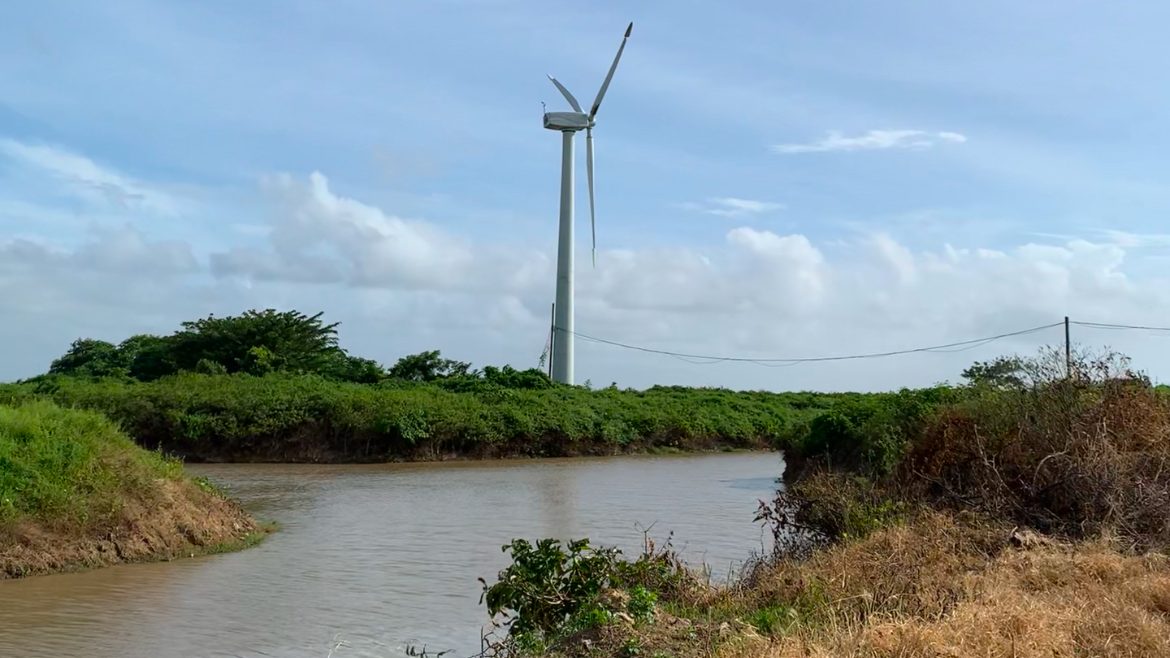
Today, a standing windmill in Berbice serves as a reminder of the wider plantation infrastructure systems that once shaped agriculture along Guyana’s coast.
Archive Entry
Across Guyana’s coast, agriculture has long depended on engineered systems designed to manage land and water. Windmills were among the technologies used during the plantation era to support these systems.
The most well documented example is the Hogg Island windmill, located in the Essequibo River. Built in 1768 during the Dutch plantation era, the structure is widely recognized as Guyana’s only surviving brick windmill and one of the oldest remaining windmill structures in the country (National Trust of Guyana, n.d.).
During the colonial plantation period, windmills were commonly used for mechanical tasks connected to estate production. These included powering sugar grinding machinery and assisting with water management on estates located on low-lying coastal land (Smith, 1962; Rodney, 1981).
Guyana’s coastal plain sits close to sea level in many areas, requiring extensive systems of drainage canals, sluices known locally as kokers, and pumping infrastructure to maintain farmland. Plantation estates relied on combinations of these systems to support sugar cultivation and agricultural production.

Today we document a standing windmill in Berbice. While it is not the Hogg Island windmill itself, structures like it help illustrate the wider network of technologies that supported plantation agriculture across the country.
Seen in this way, the windmill in Berbice becomes a reminder of the systems that once shaped agricultural production along Guyana’s coast. It reflects a long relationship between engineering, land management, and the labor that sustained plantation agriculture.
Within the archive, documenting these structures helps preserve the physical traces of that history as they continue to exist within the modern landscape.
Berbice Peace®.
Historical Context
Windmills were introduced to Guyana during the period of Dutch colonial settlement in the seventeenth and eighteenth centuries. Dutch engineers were experienced in using wind-powered technology for milling and water control in low-lying environments, and similar systems were adapted for plantation agriculture in the Caribbean.
In Guyana, windmills could be used for:
• grinding sugar cane during processing
• assisting estate drainage systems
• supporting plantation infrastructure in coastal regions
The Hogg Island windmill, built in 1768, is the best preserved surviving example of this technology in Guyana today and is recognized as an important heritage structure (National Trust of Guyana, n.d.).
Sources
National Trust of Guyana. Hogg Island Windmill. https://ntg.gov.gy/monument/hog-island-windmill
Rodney, Walter. A History of the Guyanese Working People, 1881–1905.
Baltimore: Johns Hopkins University Press, 1981.
Smith, Raymond T. British Guiana.
Oxford: Oxford University Press, 1962.
“Windmills in Colonial Guyana.” JSTOR. https://www.jstor.org/stable/40968719