Context
Coconuts are a familiar presence across the coastal regions of Guyana. Used in cooking, sweets, oil, and drinks, the fruit moves easily through everyday life. Before reaching the kitchen, however, the coconut must first be opened and prepared.
Archive Entry
The coconut palm (Cocos nucifera) spread widely across tropical regions through a combination of ocean currents and maritime trade routes. By the colonial period, coconuts were established throughout the Caribbean and northern South America, where they became an important and versatile crop (Harries, 1978).
Preparing a coconut begins with removing its outer husk.

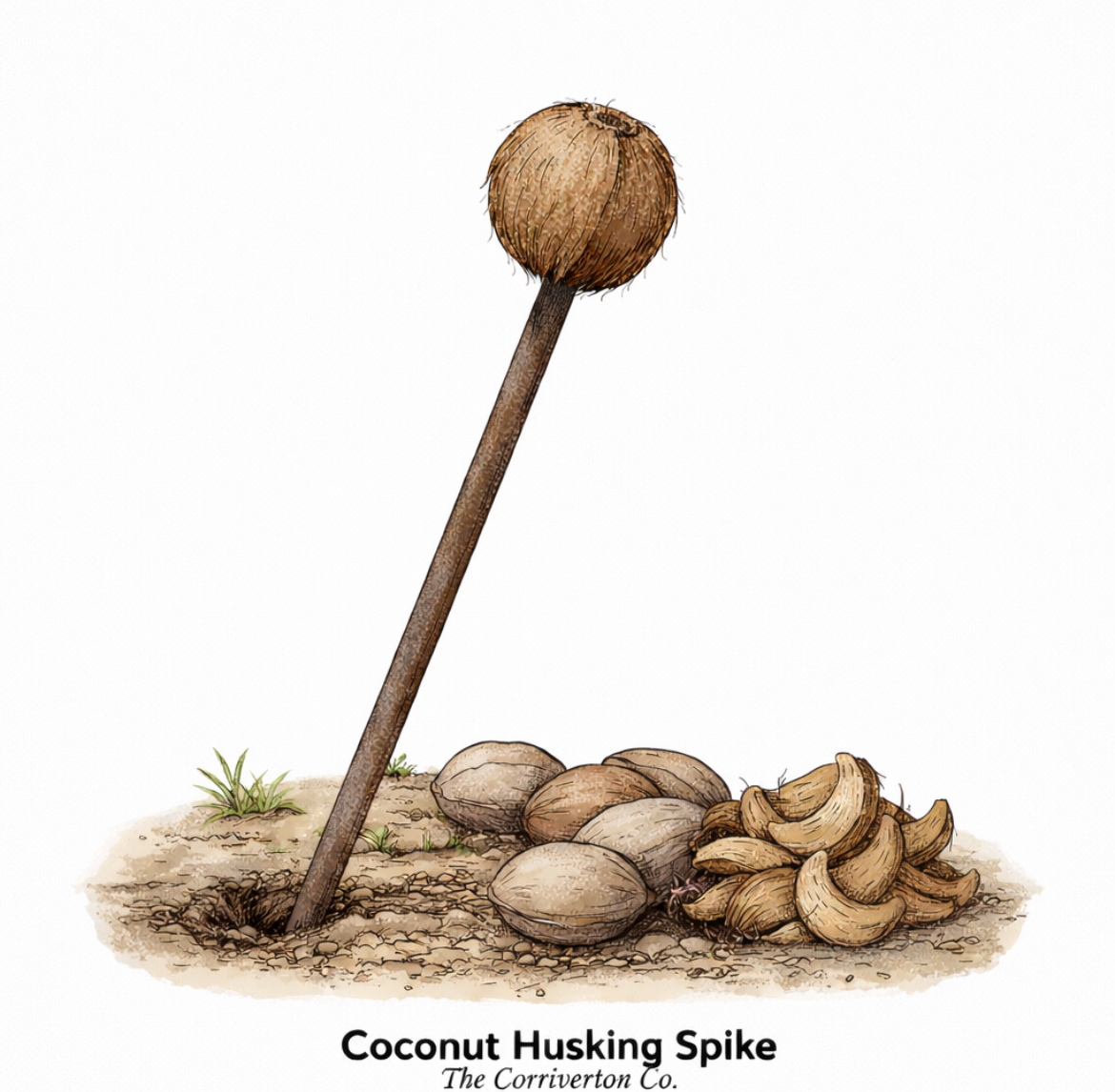
In Berbice, opening a dry coconut has long relied on a simple tool planted in the soil: a steel spike used to peel the husk by hand. The coconut is pressed down onto the spike and rotated carefully so that the thick fibrous husk separates from the shell. The movement requires balance and repetition, and the technique is often learned through observation rather than formal instruction.
Across villages and farms, the spike remains common because of its durability and efficiency. Skilled users can remove the husk quickly, revealing the hard shell beneath.
The method itself is not unique to Guyana. Similar coconut husking spikes are used across other coconut-growing regions of the world, including Sri Lanka, India, and parts of Southeast Asia, where the same basic tool is used to remove the husk efficiently before further processing (Foale, 2003).
While the traditional spike continues to be used for dry coconuts, opening fresh green coconuts has often required chopping them open with a blade.
In recent years, additional tools and local inventions have begun to appear. In one example documented for this archive, a maker who attended a technical training institute developed a handheld tool designed to open green coconuts more easily.

Within the framework of the archive, both tools hold meaning.
The spike reflects knowledge carried through generations of daily practice.
The newer invention reflects technical training applied to everyday needs.
Together they demonstrate how tradition and innovation often exist side by side within local systems of knowledge.
The archive records both as part of the living practices that shape everyday life across Berbice.
Berbice Peace®.
Historical Context
The coconut palm is one of the most widely distributed tropical plants in the world. Researchers attribute its spread to a combination of ocean drift and human movement through maritime trade networks across the Indian Ocean and Pacific regions (Harries, 1978). During the colonial period, coconuts were further cultivated throughout the Caribbean, where the fruit became widely used for cooking, oil production, fiber, and drink (FAO, 2013).
Traditional coconut husking spikes remain common in several coconut-growing societies, particularly in Sri Lanka and India, where similar tools are used to remove the fibrous husk before processing the shell (Foale, 2003).
Sources
Foale, M. (2003). The Coconut Odyssey: The Bounteous Possibilities of the Tree of Life. Australian Centre for International Agricultural Research.
Food and Agriculture Organization (FAO). (2013). Coconut Production and Processing.
Harries, H. C. (1978). The evolution, dissemination and classification of Cocos nucifera L. Botanical Review.